How Do Electric Cars Work
how-do-electric-cars-work As you drive around cities in the United States, you’re seeing more and more of them: sleek Teslas, stylish Ford Mustang Mach-Es, and practical Chevy Bolts silently gliding by. Electric cars, or EVs, are no longer a futuristic concept; they are a rapidly growing part of our daily lives. But for many, the technology behind them can feel like a mystery. How does a car move without a petrol engine, a gearbox, or an exhaust pipe?
If you’re a beginner who is curious about the magic behind these vehicles, you’ve come to the right place. This guide will break down the complex technology of an electric car into simple, easy-to-understand concepts.
The 3 Core Components of an Electric Car
Forget the hundreds of moving parts in a petrol engine. An electric car’s powertrain is beautifully simple and revolves around three main components.
1. The Battery Pack (The ‘Fuel Tank’)
This is the heart of the EV. The battery pack is a large, flat, rechargeable lithium-ion battery, typically located under the floor of the car. It’s essentially a scaled-up version of the battery in your smartphone or laptop.
- Function: It stores the electrical energy that the car uses to run.
- Capacity: Its size is measured in kilowatt-hours (kWh). A larger kWh number means the battery can store more energy, giving the car a longer range (the distance it can travel on a single charge).
2. The Electric Motor (The ‘Engine’)
This is the component that actually makes the car move. Instead of a complex internal combustion engine that burns fuel, an EV uses one or more electric motors to turn the wheels.
- Function: It converts the electrical energy from the battery into mechanical energy (motion).
- Key Advantage: Unlike petrol engines that need to “rev up” to produce power, electric motors deliver instant torque. This means the moment you press the accelerator, you get 100% of the car’s power, resulting in silent, smooth, and surprisingly fast acceleration.
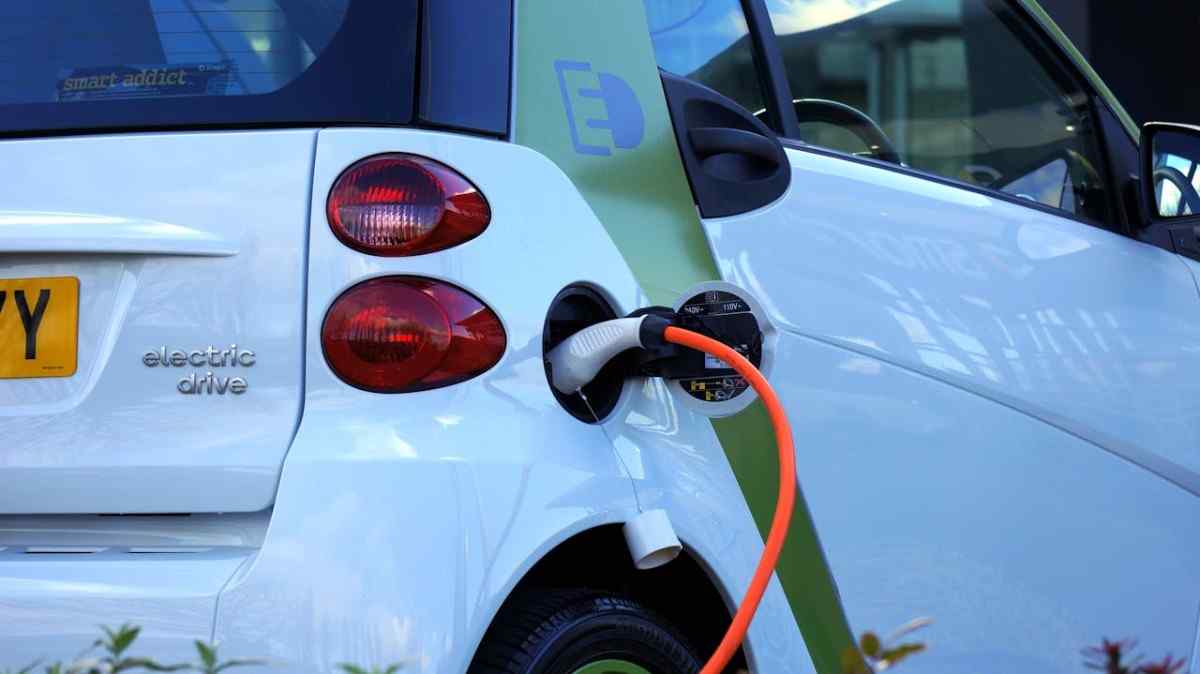
3. The Charging Port (The ‘Fuel Cap’)
This is where you “refuel” your electric car. Instead of a nozzle for petrol, you have a port where you plug in a charging cable to replenish the battery with electricity.
- Function: It allows electrical current from an external source (like your home wall socket or a public charging station) to flow into the car’s battery.
How It All Works: A Simple Step-by-Step
The process of driving an electric car is incredibly straightforward.
- Charging: You plug the car into a power source to charge the battery pack.
- Starting: You get in the car and press the “start” button. There’s no engine noise, just a quiet hum and a “Ready” indicator on the dashboard.
- Accelerating: You press the accelerator pedal.
- Power Flow: The car’s “brain” (a power control unit) draws high-voltage direct current (DC) power from the battery pack.
- Conversion: An onboard device called an inverter converts this DC power into alternating current (AC) power, which is the type of electricity the motor needs.
- Motion: The AC power flows to the electric motor, creating a magnetic field that causes the motor to spin, which in turn rotates the wheels and moves the car forward.
That’s it! There are no gears to shift (most EVs have a single-speed transmission), no oil to burn, and no exhaust fumes.
Two “Magic” Features: egenerative Braking: Creating Power from Slowing Down
This is one of the coolest and most efficient features of an EV. In a petrol car, when you brake, the energy of the car’s motion is wasted as heat in the brake pads.
- How it works in an EV: When you lift your foot off the accelerator or press the brake pedal in an electric car, the electric motor essentially runs in reverse. Instead of using power to turn the wheels, the spinning wheels now turn the motor, which acts as a generator. This process creates resistance that helps slow the car down, and at the same time, it generates electricity that is sent back into the battery pack, adding a small amount of range. This is why EVs are particularly efficient in city driving with lots of sta2. stops Three Levels of Charging
Charging an EV is a new concept for many. There are three main ways to do it in the United States:
- Level 1 (Slow): This is simply plugging your car into a standard 120-volt wall outlet in your garage using the mobile charging cord that comes with the car. It’s the slowest method, adding only about 3-5 miles of range per hour, but it’s convenient for overnight charging.
- Level 2 (Medium): This is the most common method for home and public charging. It uses a 240-volt outlet (similar to an electric dryer) and a dedicated charging station. A Level 2 charger can typically add 25-40 miles of range per hour, fully charging most EVs overnight.
- Level 3 (Super-Fast) / DC Fast Charging: These are the high-powered charging stations you find along major highways. They provide DC power directly to the battery, bypassing the car’s onboard charger. A DC fast charger can add 100-200 miles of range in just 20-30 minutes, making long-distance travel in an EV possible.
Why is an Electric Car So Different to Drive?
- Silent: The lack of an engine means the car is virtually silent at low speeds.
- Instant Acceleration: The immediate power from the electric motor provides a thrilling “push-you-back-in-your-seat” feeling.
- One-Pedal Driving: Many EVs offer a “one-pedal driving” mode. Thanks to strong regenerative braking, you can accelerate and slow down to a complete stop just by using the accelerator pedal, rarely needing to touch the brake.
- Lower Center of Gravity: The heavy battery pack is located in the floor, giving the car a very low center of gravity. This makes EVs feel incredibly stable and well-planted when cornering.
In conclusion, while the technology is advanced, the principle behind how electric cars work is far simpler than that of their petrol-powered predecessors. By replacing a complex engine with a simple and efficient battery-and-motor system, EVs offer a quieter, quicker, and cleaner driving experience that is defining the future of transportation.